
NOT BROKEN....but relationships make me feel something isn't working!
Trauma singly or complexly can fracture the self and requires stepping into a healing journey and finding wholeness. At times a lasting relationship feels like the proof we need to be NOT BROKEN.

This article is for both those who identify as “holding trauma” and those who enter into an intimate relationship with them. Mostly this applies to dating and marriage but it can provide useful to family of those who hold trauma.
Holding trauma refers to the physical and emotional ways our bodies retain distressing experiences. When we encounter trauma, it can become encoded in our brain, memories, and even our muscles and organs given the way research has advanced our understanding of trauma encoding on the Central Nervous System (CNS). Many holding trauma have stuck survival responses: fight, flight, freeze or fawn/appease, that do not move the individual towards that “I am safe now” feeling and only recycle old patterns. This reinforces the experience such that relationships never truly get to that “safe” feeling inside. Each person’s experience of holding trauma is unique, but it’s essential to recognize and address it. Seeking professional support or practicing somatic techniques can help release trauma effectively as part of the healing process. There is a wonderful site of resources offered by the U.S. Department of Veteran’s Affairs and you can go here to self-screen for PTSD as well as look at the various methods to gauge the best forms of trauma healing modalities for you. If you are a loved one, the entire site has many resources to pull from. If you suspect your body is holding onto trauma, consider seeking counseling or exploring simple ways to support your body through a trauma response.
You will need to work together with your provider to choose a treatment that makes sense to you and suits your needs. This is called shared decision making. During this process, your provider will give you information about the pros and cons of different PTSD treatments. Don't be afraid to ask questions or tell your provider about your goals and preferences. You can have say in which treatment you receive. Ultimately, you and your provider can arrive at a decision that you both agree on.
The focus of this article however is on what many find is the real goal in healing trauma, to find that lasting partnership or otherwise be able to form trusting and meaningful connections. Trauma can damage the nervous system in profound ways that affect our threat response system. There are other articles on this Substack that explain the way our Polyvagal Ladder in our nervous system acts to help us achieve that safe, secure and ready for connection state after we move through either collapse or freeze or into fight and engage and then climb up and out of danger through the use of our sensory integration (5 senses, interoception, proprioception= neuroception). What is important from all of this somatic psychology and neuropsychology education is that trauma profoundly affects one’s sense of safe, secure and ready for connection state.
Those holding trauma find it very hard to explain this and harbor thoughts “I am broken”. At times, the reverse can transpire and a person holding trauma can see threats in interactions with loved ones and respond as such, inspiring the other to feel frequently wrong or bad for them somehow with no evidence as to how or why. This is because it is coming from a uniquely altered threat response system. The stories or narrative of “this is what happened” can only go so far as to explain the disconnection and sense of threat. Many couples and families would do best by seeking out their own awareness of what threatens them and what they hold in their bodies from their lived history in order to repeatedly be able to validate “that can happen, we both can get activated in ways from deep in our stories from the past”. Sometimes these are just felt sense memories and not explicit. Both partners (family as well) entering therapy for the tools of reprocessing can greatly benefit the relationship. The article on Relational Healing, where a tool called the Feedback and Processing Loop is laid out, is one such tool that is valuable for couples.
It is essential that those holding trauma do their own work in therapy and communicate to their loved ones that they expect connection and communication routinely. Triggered states cannot be researched and explained easily as a full stop and static awareness of “what is happening for you”. It takes an ongoing dialog for both partners to engage in repeatedly and the understanding that relationships follow this very important formula repeatedly:
HARMONY»>DISHARMONY»»>REPAIR»»>HARMONY»»DISHARMONY»»REPAIR
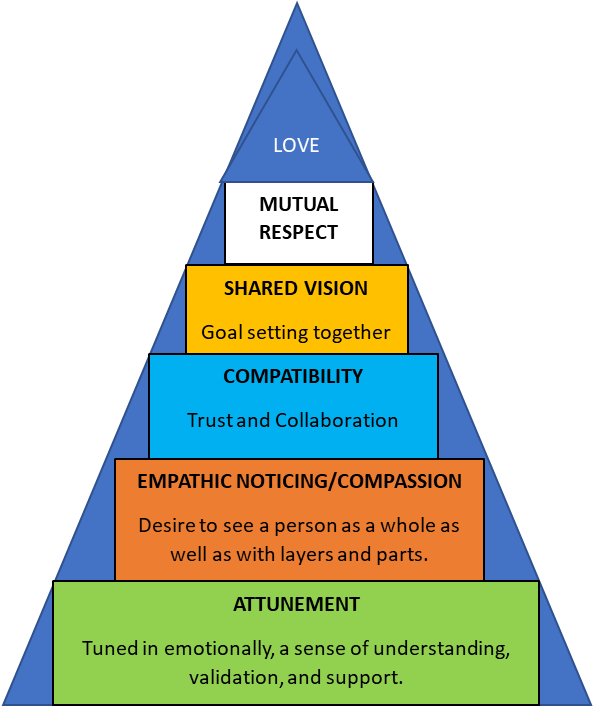
This formula represents how we constantly acknowledge there are times when one of us has a story line about what is happening in the relationship that is very likely activated from past pain and needs a repair conversation. This conversation is not about fixing but about getting back on track to compatibility, mutual respect, shared vision and love. This is a conversation not a method of feeling physically attracted and intimate again although that can manifest as an outcome. The Model of Emergent Love should be kept in mind. I have written an ARTICLE on the Emergent Love Model of Therapy is explained as analogous to this (parts 1 and 2). The diagram of what kind of love the couple builds here is below. We do not propose that we are starting with love, and therefore an argument or holding trauma triggers breaks love. We are forever building love. This is healthy for all couples. Therefore, NOT BROKEN, indeed. We need to empower both the trauma holder and the loved one to join responsibility in this and that it is valuable to both.
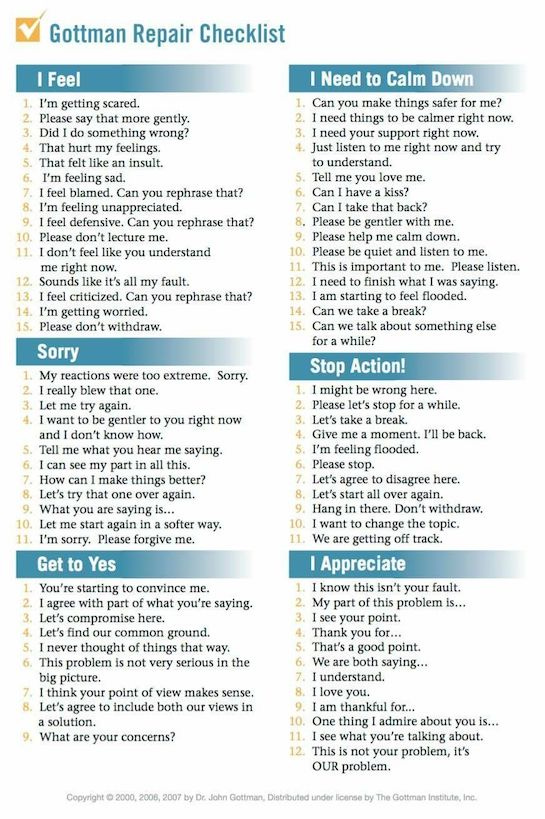
A tool from the GOTTMAN METHOD of therapy is the Repair Checklist depicted below. There is no better method for understanding this tool than live example. As always, I am a Certified Clinical Trauma Professional Level 2 with 17 years of experience, I think you can trust this. However, trusting me here without the felt sense of me there in a session, requires more and leads me to the decision to always use lived experiences from sessions and my own life. Here below is both the Checklist Tool and a blend of experiences from sessions and life that is tailored for use with the Tool.
I wanted to feel him, we were dating a few months and I told him about my trauma. I told him it had been repressed and I was new to dealing with it all. I told him that I had other trauma that I can see is related. I was not able to link it yet to us and how it could affect things, I hoped that somehow the physical intimacy would go well, and it wouldn’t matter. I wanted it to feel like I was finally safe, and I told him I was ready to let go of my freeze response, but that I couldn’t let go completely and I would need patience. I was able to have sex by practicing my breathing, but I couldn’t get into it and find that wonderful wholeness I wanted. He didn’t notice. Then he fell asleep quickly. I don’t know how long I stared at the wall, in between myself and a wall of pain, willing it to just stay back. He kissed me goodbye in the morning, I could tell he felt like we had passed into something more secure. I felt too much and nothing all at once. I know I felt used by him, I felt crazy for feeling that way, he said “I love you”, so I had a mask of okayness on in acceptance, as if that was equal and enough. I felt empty still. More so than before even. What am I supposed to tell him, do I fix this feeling on my own in more therapy? I just don’t feel like anyone will ever love me and help me feel safe, maybe I don’t even know myself? I can’t feel this way, I can’t fail, I have to figure this out and go to therapy.
In the example above, the individual comes to therapy and does figure many things out. They get to a point where they are ready for sharing “what is happening for me with these triggered responses I couldn’t explain before is…….”. The trouble was the partner was emotionally distant at this point and there was a wall where they both were out of sync. One, the male, had felt he had been open and patient but retracted in fear and went behind a wall of overworking an unavailability when he felt her withdraw into therapy to figure herself out. She went to Yoga and worked on things reading and was less available so he prioritized his company and took on more things in subconscious repression and retaliation for the abandonment. She was in therapy like her life was on the line, she may have felt distant but was filled with a purpose and didn’t notice it as a threat. They needed repair badly but there was only COMPLAINICATION. This is when both complain as communication either explicitly, implicitly or internally. They think they know what the other is doing to mess things up. It can be expressed or repressed and ruminated on in the mind only/ It can be launched from a distance like arrows in a dispute, or even fired at close range in a heated blow out fight.
For this couple we display below what each could do to use the Checklist (Note: The example is a cisgender heterosexual male-female couple, but the list is useful in all relationship dynamics where repair is needed):
Male:
Using the list he selects: “That hurts my feelings”, “I am getting worried” and “Please don’t withdraw” from the list. I worked with him to identify that it hurt his feeling she felt she had to go away to figure things out. He expressed it logically makes senses, he is not a therapist, but he was “getting worried” that she would also figure out they were wrong for each other or something else he would be left out of. The last statement was “Please don’t withdraw”. Although he was now the one withdrawing into work, it was almost a retaliation reaction, mirroring what he felt she was doing to him and subconsciously defensive against pain. More than understanding trauma, the sharing of his emotional experience helped the partner then also use the list.
Female:
Using the list she selects: “I don’t feel like you understand me right now”, “I need your support right now” and “Just listen to me right now and try to understand the way I see it, it doesn’t mean you do anything wrong”. We added this last part to the third selection given she felt he often went to that place and it was a bad dynamic given she felt her trauma made her bad and wrong at times and could not deal with seeing that in him when she needed support. Using the first statement she explained he didn’t understand the way trauma reactions feel “both real and crazy at the same time it is amazing I have learned to stay present to talk about things”. She felt he didn’t understand it feels “like losing everything to feel this way”. When she used the second statement, she accepted that he may feel conversation is not enough and sometimes hard so they agreed “what do you need to support you right now” was something they both need to ask more and not always in disharmony or repair. Lastly, she used “Just listen to me” and expanded upon the need to listen to the story that happens for her, not listen to explain why her story is not how he meant to come off or if is about some other situation, not explain anything, just fine tune his understanding of “the way it is happening for you”.
The resources in various websites such as the U.S. Veterans Affairs National Center for PTSD are vast and truly worth exploring but nothing replaces the tools for remaining relational. This primarily means that it is not about the way you figure out your partner and master them, their issues, their triggers or their vices. It is about being relational with these things, opening space for understanding not elimination of disharmony and problems. Holding trauma opens up an amazing growth opportunity called Traumatic Growth, that can be an asset to any relationship if the engaged community, family, workplace, organization or partner can join in the owning of HARMONY>DISHARMONY>REPAIR and the tools for Relational Healing.
Please reach out to me on LinkedIn. I can offer you an invitation to the ENYA, Everyone Needs You Always, community. We exist as a community that silently support one another in number and shared resources. You don’t have to worry about commenting or risking a boundary, everyone exists there only by invitation and are offered the chance to unique shared resources.