

Help Your Stuck in Survival Mode Nervous System
Did you watch the clip? If you did then you know all you need to know about Neuro-somatic intelligence. How? Because you felt the story through this intelligence. I am a trauma therapist, and this is the hidden gem of healing I am here to explore with you today. If you have been wondering why talking about what bothers you, what you remember about the past, or why you feel so stuck hasn’t helped, it is due to the fact that talking about things does not release what is stuck in our nervous system’s story, in your somatic intelligence. The felt sense of what has happened in life is still there in an activated nervous system that has become very good at sweating all the things and disguising this as the hard work of life and moving forward. There is a way to release from survival mode. Watching the short clip is an exercise in awareness. This is not what we do with our own lives. We do not sit silently and play back all the clips; survival mode protects us from our own somatic intelligence. However, you get to a certain point, and you just know. You are reading this because you know. Read on and feel this be true to you.
The Polyvagal Ladder comes from a neurological and somatic concept of our emotional and mental health that speaks to where in the body our life narratives may have stuck points. We cannot talk out all that has happened because it is not just a What Happened, it is a Where. When you watch the above video without sound it is a mini-experience of the neuro-somatic reality that stories hit us as a sensory experience, and we make up the meaning based on this. Our life stories are all on a timeline called “my life” but not all the memories are clear episodes, and then there are the ones we don’t know how to tell because they are only felt and not recorded the same way. They still demand we tell them and release them. It is very likely they hold pain and want to be released so we can find the lesson. All stories do have something to teach us, yours is no different. Let’s learn from an experience I had recently the demonstrates how to blend Neuro-somatic intelligence and the Polyvagal Ladder concept with good old creativity for release.
Recently, I got the idea that there was healing left for me to do. I have been becoming more aware of what it means to feel safe and secure in my life and I floated back to childhood. Today I am aware I was going through a lot. I have childhood trauma that surfaced after a tragic loss during the pandemic. As mentioned, I am a trauma therapist, and the pandemic changed the way I work tremendously given the boundaries shifted between therapist and individual seeking therapy. People were coming to therapy knowing I was inside at least one collective trauma, right along with them, there was no way I could be more expert than them and I decided to embrace that. So, I pulled back into my own healing right along with many others feeling they really had nowhere else to go but inward. The goal was to be as authentically with everyone as I could, but it transformed into another piece of inner work that would come to be authentic and just for me. This is the backdrop of the past few years. Now I seek healing out in new ways that are more creative and can work for you too, no matter where you are in deciding there could be a past “thing” still affecting your life.
I began writing and found a hidden chorus inside me. I felt like I needed to feel myself speak but I am a listener, and it didn’t feel as though I could. I returned to my somatic training and realized that I kept humming to myself as I wrote, as I went hiking, and as I tried to stop thinking and go to sleep. There was a sound for everything I was feeling, so I felt like I needed to tap into that. I am not on a course to become a professional singer so when I shook like a leaf in a singing class and only found strength when I just ended up singing something I made up, Eve Soto, the wonderful guide for the course suggested I go to the songwriting class.
I knew immediately this was the right track because there was some authentic energy between Eve and I in that moment and she knew I was there to heal something unspoken. So, I went as a way to continue to release emotional wounds encoded in my limbic system’s implicit memory. My body knows it has not been singing and humming to itself for comfort in decades. I sensed I needed to bring this back now and not always turn to thinking and understanding stuck emotions by figuring them out or explaining them, but truly let them complete themselves and why they are showing up in a body centered way.
In the class we were prompted to watch the clip above and let it inspire our own lyrics. I could sense my system immediately feeling the connection to what I do as a trauma therapist. I felt the story I witnessed and the pull to make it the familiar one my brain already knew was the “accepted version” but held on to the mission to let this inspire something unique and new. I was nervous but realized it was possibly the good kind and not the bad. The class, when they heard my lyrics could sense the story I felt, they didn’t laugh or disagree. I knew then I had done something it can take months to teach to people that come to therapy, I saw a story through the felt sense, totally unafraid of what I would find.
Many people have had bad experiences both telling and not telling what has been going on in their lives. We wait until the need is large and dump it or repress it trying to protect others. In both instances we don’t feel what we are afraid of, we just label it a bad story that feels worse in the telling. We assume it feels worse because we spend so much time moving on in spite of or address things in critical, managerial and impulsively avoidant ways that numb it away.
The way I was able to use creative song writing, following my humming, singing it out in the group imperfectly through feeling a life story that was not my own but somehow was, is a method of climbing up the ladder to social connection and feeling safe. The group understood my words and felt my music despite how in tune or off, they felt it completely because of my ability to let this story hit my system and so I poured that back out and it was understood. However, we rarely get this experience with our own stories. Largely, we try to talk about things as a release, but it can fall short. I encourage you to watch and feel as an exercise of what this could be like. I am normally a very shy singer, I have not even heard myself until recently, but I want you to listen to my raw expression of this at the end of the article. I am not afraid because I felt it, and it feels real and authentic. Feeling and releasing emotions in a body centered way is part of self-care and self-regulation leading to authenticity.
CLIMB BACK UP THE LADDER
Climbing back up the Polyvagal ladder to emotional safety and desire for connection to others is not a talk about it process. We are disrupted in life largely by trapped threat activations that never complete themselves. Remarkably, we can carry on in survival mode for decades. The accomplishments we think up to drive us out of our bodies and into productivity are a powerful disconnector.
Take a moment now and breath in. Place your hands around your middle, underneath your ribcage and breath in again as if you are stoking the fire in your heart. Now breath in one last time into your core, breathe into the underneath of your hands and feel from the inside of yourself how all this hard work really is in there. Imagine how you look when you are not in this awareness but when you are making the mental list of what to do, or thinking about what is wrong, why you haven’t gotten to that important thing or made that appointment or done the things you were supposed to do last week and keep moving around in avoidance loops. This is what you look like, can you feel that? Somatic intelligence tapping will let you release in ways that release more than just stress but the hidden stories of not good enough, not there yet, something is wrong with me, I missed out, I keep making mistakes, I don’t know, who is there for me; all the ways we manifest the Saber Tooth Tigers our ancestors ran from be we run from only within our minds. Our threats are different and we have to work with the somatic intelligence of the past and blend it with an awareness of our internalized mental projection of our story.
The amygdala triggers our threat response system as part of a natural process meant for us to ultimately orient to safety, however at times humans, unlike other animals, disrupt their process by attempts to use what I will call the Front Brain for simplicity, and altering the response cycle such that it does not complete itself. There are rich tools in what I will call the Back Brain, again for clarity and simplicity, tools that come largely from the information highway that is our Vagal System, the large cranial nerve that courses from the brain down through our facial muscles into our organs through the branches of its trunk that is backed by the spinal cord. Tools that make up the Sympathetic nervous system and include the Back Brain goodies that come to us from the information highway of our Vagal System are the way we can imagine a ladder inside ready for us to climb up to safety. This system that is like a ladder is depicted below.
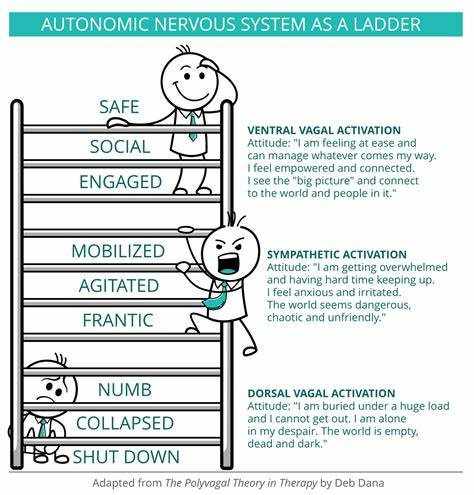
The Steps of the Polyvagal Ladder
At the top of the ladder is “safe and social.” When people are on this third step of the ladder it is because they are in the ventral vagal state. In this state, people can connect with others because they feel tied to the present and do not feel like they are under attack. This is what I experienced in Eve Soto’s Class.
In the middle of the ladder is when people are in sympathetic activation. When people are on the middle step of the ladder it is because their fight or flight response is activated and their nervous system senses that there are threats in a person’s environment.
On the last step of the ladder is dorsal vagal activation. When people are on the last step of the ladder, it is because they are in a state of hypo-arousal. In this state people often feel frozen, shut down, and they cannot move to plan things or think more sluggishly and give up. They also have trouble connecting with others because the world feels fuzzier, meaning other people can feel illusory, like the value in connecting with others is dulled and doesn’t register as a need, desire or possibility, there is no connection urge.
Takeaways from the Polyvagal Ladder
The Polyvagal Ladder explains that when we are in a shutdown state, we can’t get back up into the safe and social zone until we go through the sympathetic activation because part of what brings us out of that shutdown state is getting more sympathetic activation. Being in a very angry or very anxious state is uncomfortable, so sometimes we can try to calm ourselves back down to the point that we go back into the dorsal vagal hypoarousal state.
The desire to no longer be anxious or angry can cause us to get stuck between the fight or flight and the numb, “stuck” state. When we are stuck going between the bottom two levels of the ladder, we are never able to reach the safe and social zone at the top of the ladder. Part of the process of coming out of the shutdown state is to move into that activated, anxious, or angry state, before you can move into the calmer state. There are no skipping states. I, for example, had to feel my lowered mood, the time I was spending helping other people work through trauma had overshadowed my own tender spots that still need tending. I will write more articles on tending to your vagal system because this is not a one-time process. Our nervous system is our total health operating system, and it needs chronic upkeep. My depletion, of short duration, is good, as is the shaking anxiety needed to come out of it. In the group I worried if I would be able to share. I had to feel the self-doubt signing up for the course, sitting in it, and in willing my body to stay while hearing my own mind say, “just pass when it is your turn”.
Oftentimes we don’t like to feel anxious or angry so we can be more comfortable in the shutdown state, but we can’t be relational from that place and like it or not, it is science, we cannot get back up the ladder to a felt sense of safety without the sense of safety that allows us to be seen, even if by a trusted few. Just knowing that being in the uncomfortable nervous state is on the road to getting you where you want to go can be helpful in pushing through it before turning to something like overworking, “situationships”, dieting, binging, perfectionism, over exercise, drugs or alcohol to numb those uncomfortable feelings.
Don’t Worry Shifting States is Normal
Throughout the day we shift through these states. We work our way up and down the ladder. Some of us live mostly in the ventral vagal zone, but others, often due to adverse life circumstances and trauma, tend to spend more time further down the ladder and have a harder time “climbing” up.
The more time we spend on different points on the ladder, the more we’re likely to get stuck in negative patterns. The psychologist, Steven Porges, Ph.D, even suggests we develop related physical symptoms related to the ways we can be stuck in our threat activation states and operating in a dysregulated hypoarousal or hyperarousal state for decades, changing our neurobiology and manifesting all sorts of symptoms we call physical but have nervous system connections.
Leading a Polyvagal-informed life is somewhat of the encouragement in this article. I offer it in therapy when I take a somatic approach and offer tools to help you be closer to the top of the ladder, more of the time. In Deb Dana’s excellent book, The Polyvagal Theory in Therapy which informs this article, there many tools for mapping out your own nervous system ladder, including how you can help yourself climb up the ladder. The tools I have collected in Therapists Are People Too, now in editing and with author’s note and articles shared in this Substack, are also of the mindset that our stories and what is keeping us stuck on the Ladder, can be beyond “just talk about it”.
How can this theory help you?
Understanding your Neuro-somatic intelligence and the nervous system in this way can change the way you think of these states in yourself. Therefore, there can be less self-judgement and more compassion for your state when you know it is merely a rung on the ladder inside you and there is a way back to safe and secure.
By recognizing what state, or rung, you are on in a given moment, and understanding how you shift between states, you can change your state so you can feel connected and safer more of the time. You can feel less hopeless when you’re in the dorsal vagal shut down state, as you’ll know ways to help yourself out of it. You can also more easily understand anxiety and fear as a necessary process and not wall off or demean yourself from enlisting the help of others in this, since as mammals we need connection with others to feel safe.
This theory, as I mentioned above, is especially relevant for those with trauma in their background. A trauma history often creates a hyper- or hypo-vigilant state, where either one is scanning for safety all of the time, and one can interpret neutral events or interactions as threatening ones, or one is shut down and depressed. This is a natural result of trauma as our nervous systems have had to protect us against danger and have now got used to that protection mode. The good news is that through positive connections (and possibly some therapy) we can help retrain the nervous system to be able to relax and feel safe.
For more information read Deb Dana’s article A Beginner’s Guide to Polyvagal Theory. Dana also has worksheets available but do check her guidelines first from her other writing to make it safe and to get the full benefit of the exercises. I would also be happy to help you on your journey and encourage you to stay posted and subscribe below. All the tools are embodied although some are more geared towards a better understanding of the narrative of your story, and some are for clearing and reprocessing without explicit understanding that can be talked out in a traditional “get it off your chest” way.
Much of the embodied work I specialize in helps regulate nervous system states to bring you “up the ladder”. See all my articles here and on ENYA Page, Everyone Needs You Always, to do understand yourself and do this inner work.
Listen to my raw and real vagal toning experience. This is not the voice of an expert singer, and while I may be trauma specialist, this is the voice of someone trying to heal and connect with you in your healing journey. Consider subscribing if you feel this!


